

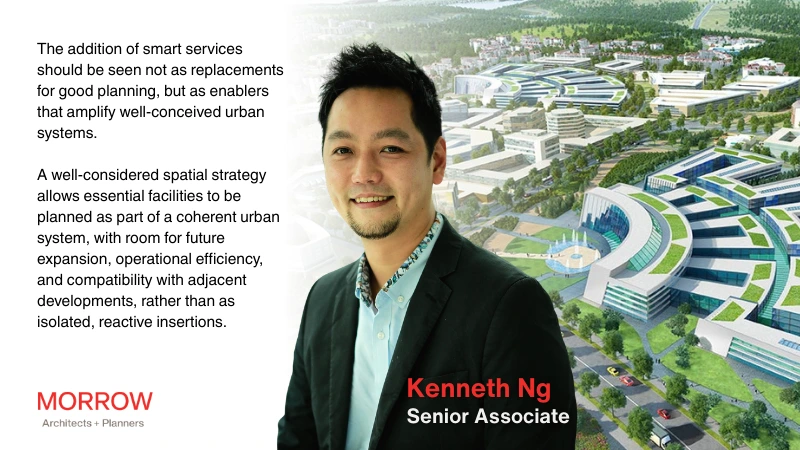
“A smart city should not be defined by the technology it deploys, but by how well its urban structure is designed to absorb, support, and scale that technology over time.”
City leaders often proclaim, “Let’s build a smart city.” However, the more important question, which often goes forgotten, is whether the physical structure and planning of the city has been optimised to account for and support the smart technologies, or are these smart technologies simply added onto the urban landscapes as an “outer layer”?
The distinction is similar to the difference between a conventional mobile phone and a smartphone. While the physical form such as its screen, buttons and basic functions may appear similar, a smartphone only becomes “smart” when it is designed to support applications, connectivity, and data exchange. Without these, it remains functionally identical to the phones we saw 20 years ago.
Similarly for cities, their smartness is not defined by slogans or isolated technologies, but by intent, structure, and integration.
At its core, the pursuit of a smart city must be anchored in clear objectives. These typically include improving public convenience, enhancing daily operational efficiency across education, work, and business, reducing carbon footprint, and building a sustainable and resilient urban environment.
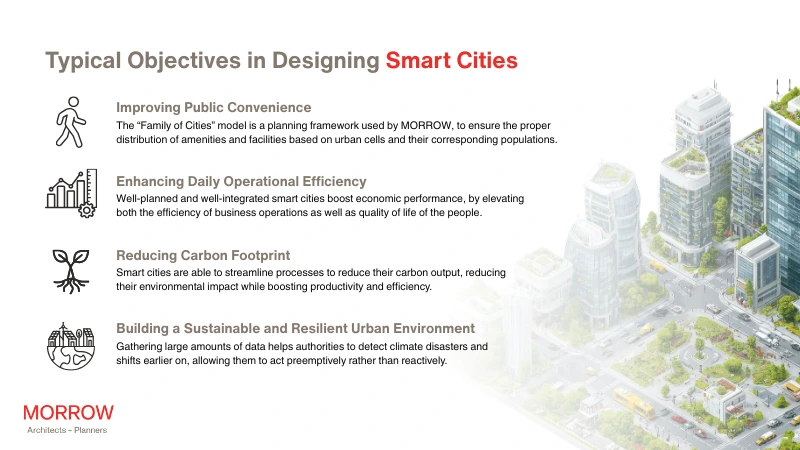
As urban planners, MORROW believes that an intelligent urban plan should already embed many of these objectives, which is reflected in the urban plans prepared by our team. Through thoughtful density distribution, integration of mixed uses, and long-term land safeguarding, such plans reduce travel distances, shorten travel times, and create flexibility for future, unforeseen development. These planning principles form the foundation upon which smart initiatives can be built and integrated into the landscape.
In this sense, the addition of smart services should be seen not as replacements for good planning, but as enablers that amplify well-conceived urban systems.
Smart Infrastructure: Hardware, Digital Backbone, and Spatial Planning
Once objectives are established, the next critical step is to understand how smart services actually function, and what physical infrastructure is required for optimal performance. Smart cities rely on an extensive ecosystem of hardware and support systems. These include power and water infrastructure, telecommunications networks, satellite systems, data centres, integrated command and operating centres, as well as office and laboratory spaces for technology-driven industries.
These components are not abstract ideas; they are essential functions which demand significant land, energy, and spatial resources, making early and careful planning essential. This is particularly evident in the case of data centres and digital infrastructure, which form the backbone of smart city operations.
Smart services depend on compute power, data storage, network connectivity, and reliable energy supply. In Singapore, for example, national plans anticipate expanding data centre capacity by more than one-third, adding an estimated 300–500 MW of compute capacity to support AI, cloud services, and broader digitalisation (Source: EDB).
Without the intelligent urban planning which was carried out in Singapore’s early days, it would not have sufficient space to accommodate even close to the 80 data centres which exist today on this small little island, a number which will continue to grow through the years.
At the same time, such infrastructure introduces real constraints. Data centres presently account for about 7% of Singapore’s electricity use, which is projected to rise toward 12% by 2030 (Source: IMDA)
In land-scarce urban environments, planners with various expertise must therefore balance site selection, utility provision, cooling strategies, and integration with surrounding uses, ensuring that digital infrastructure does not compete adversely with housing, industry, or green spaces, nor exacerbate traffic and environmental stress.
A well-considered spatial strategy allows these facilities to be planned as part of a coherent urban system, with room for future expansion, operational efficiency, and compatibility with adjacent developments, rather than as isolated, reactive insertions.
Smart Streets, Digital Twins, and the Human Experience
With physical infrastructure in place, attention turns to software, platforms, and services that directly enhance quality of life and ease of doing business. Among the many domains of smart development, streets and public spaces are particularly impactful, as they form the most immediate and commonly used intersections between the people and the city.
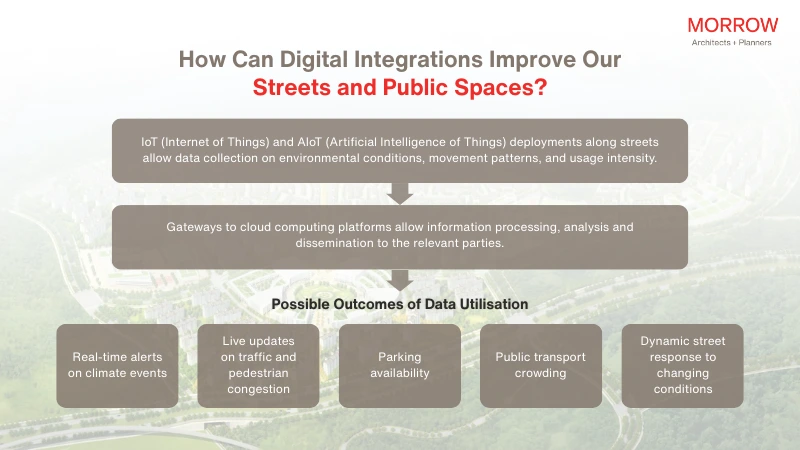
A well-planned and well-constructed streetscape already supports walkability, safety, and activity. Digital integration can further elevate this experience. Through IoT and AIoT deployments along streets, data can be collected on environmental conditions, movement patterns, and usage intensity. Gateways to cloud computing platforms then allows this information to be processed, analysed, and disseminated, either through integrated command centres or mobile applications, directly to users, businesses, and agencies.
Practical applications, which have been implemented in various cities around the world today, include:
For public agencies, these systems offer deeper operational insight. Data analytics can reveal energy and water consumption hotspots, predict critical situations, and trigger early intervention by relevant task forces. One practical example would be sensors embedded within tree trunks or root systems, allowing authorities to detect abnormal movement and warn the public of potential tree failure before it occurs.
At a broader scale, digital twins and data analytics platforms play a growing role in smart urbanism. Tools such as comprehensive city-scale digital twins enable planners and designers to simulate transport flows, building performance, wind and solar impacts, and even autonomous vehicle routes before physical implementation. These simulation-driven approaches reduce risk, improve coordination across sectors, and support evidence-based decision-making for long-term urban transformation.
High-density urban settings increase the potential value of smart systems, but also heighten the risk of congestion and sensory overload if poorly designed. Architectural integration of sensors, connectivity, and equipment must therefore be designed in tandem with the built environment and human experience to support inclusive public spaces, walkability, accessibility for the elderly and vulnerable groups, and a resilient urban form that enhances, not disrupts, everyday life.
Conclusion: Planning First, Smart Second
Ultimately, a smart city is not defined solely by the technology it contains. It is the end-result of an intelligent urban plan that drives liveable, sustainable and resilient development, complemented by digital solutions that enhance operations and extend the performance thresholds of physical infrastructure, while improving the lived experience of the public.
Ideally, smart technology should be embedded early in the planning and design process, rather than imposed later, so that it can support the plan rather than dictate it.
To use the analogy of a house, whether it is designed as a conventional or smart home, it still requires living spaces such as kitchens, bathrooms, and bedrooms based on the needs and number of its occupants, just as a city must meet the fundamental needs of its population.
Smart home planning, when introduced early, allows designers to anticipate the number and locations of data points, cabling routes, and energy demand, optimising efficiency without altering the core spatial logic.
As smart technologies continue to evolve, many urban solutions will shift from being “nice to have” innovations to essential urban utilities, much like how Wi-Fi networks have gradually become an essential part of every home and office today. The expansion of smart solutions and normalisation of hybrid work across industries makes it increasingly important to re-activate and rethink our streets and public spaces as places for daily life, not just ways to move from point A to B.
Possible examples include smart office pods with climate-responsive controls integrated on the street, including residential areas and urban parks. Innovations such as these would support flexible work patterns while reinforcing street vitality, enabling people to live and work closer to home, and further strengthening the integration of work, life, and community within the urban fabric.
With the rapid advancements in modern day technology, we have come to realise that our society has reached a constant state of flux. However, for urban planners and architects everywhere, one thing that will continue to hold true is that embracing smart technology within our built environment is not merely about chasing novelty, but intentionally putting in place good planning and design to ensure our cities remain adaptable, inclusive, and future-ready.

Kenneth Ng is a landscape architect and urban planner with over a decade of experience across Russia, China and Singapore. He has delivered a diverse portfolio of urban planning and landscape projects, including major commissions in China and Kazan. His broad expertise spans projects of varying scales – from large-scale Constellation City strategies such as Weifang City and Greater Kunming, to specialised developments, including high-tech parks and tourism districts such as Kazan Innopolis and Yunnan Dongfengyun.
Kenneth was the key designer for the Singapore Pavilion at the Shanghai World Expo 2010 and was involved in the Singapore Round Island Route Plan. These experiences have positioned him as a sought-after contributor at international conferences, academic institutions, Chinese forums and media interviews, where he shares perspectives on urban transformation, landscape strategy and integrated planning.